Colin Nuckolls
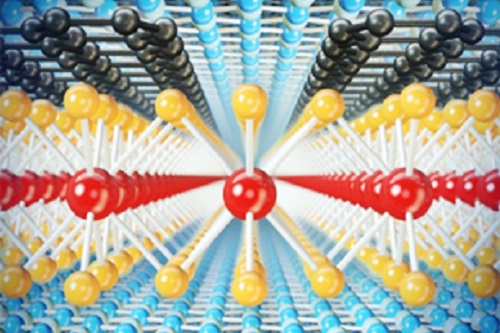
Assistant Professor The Nuckolls research group is interested in designing and synthesizing new types of molecules that have interesting electronic properties. This approach has tremendous power because new types of molecules can be synthesized that have information written into their structures that encodes their own self-assembly. In this context, self-assembly is a tool that uses relatively weak forces such as van der Waals contacts, hydrogen bonds, π-overlap, and salt bridging to predictably create one, two, and three-dimensional nanoscale objects. The plasticity and reversibility of these weak forces provides rapid access to complex assemblies from informationally-rich but relatively simple building blocks. This inherently bottom-up approach provides complexity useful for nanoscale electronic materials. The cornerstone of Nuckolls group is in finding general methods to assemble and interconnect complex molecular structures with metallic and semi-conducting surfaces. Three systems, currently investigated, are shown below. On the left is a new class of molecules that assemble due to a synergy between hydrogen bonds and π-stacking. Individual strands of molecules (1 molecule wide but micrometers in length) can be isolated. Ongoing experiments with IBM are measuring the electrical transport properties of these molecules. In the middle figure is a new class of cruciform π-systems. These molecules tend to adopt upright conformations on metallic substrates - the conformation that is required for molecular electronics measurements. Collaborative research with Lucent Technologies is measuring the transport properties of individual molecules based on these structures. In the right-most figure is a class of molecules developed in the Nuckolls group that are isostructural with pentacene. In thin film transistors, these molecules show relatively high mobilities, but do not suffer from the drawbacks of pentacene, namely environmental instability and difficulty in derivatization.
|
![]() |