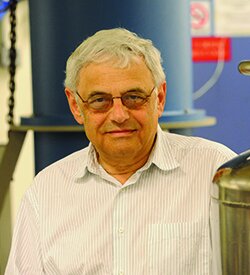
Irving P. Herman
Professor of Applied Physics
Columbia University
Tel:(212)-854-4950
Lab:(212)-854-6666
Fax:(212)-854-1909
e-mail:iph1@columbia.edu
|
Irving P. Herman
Chair, Department of Applied Physics and Applied Mathematics (APAM)
Director, Materials Research Science and Engineering Center (MRSEC)
(The Center for Nanostructured Materials)
Member, Columbia Nanocenter
Member, Columbia Center for Integrated Science and Engineering
Professor (Optical and Solid State Physics)
S.B., Massachusetts Institute of Technology, 1972
Ph.D., 1977
Biography:
IRVING HERMAN graduated with S.B. and Ph.D. degrees in physics from
M.I.T. in 1972 and 1977. From 1977-1986 he was a member and section
leader in O-group within the Physics Department at the Lawrence
Livermore National Laboratory, where he was engaged in research in
laser isotope separation of deuterium and tritium, and the use of
direct laser writing in thin film processing. In 1986, he joined the
faculty of Columbia University, where he is now Professor of Applied
Physics, Director of the Columbia Materials Research Science and
Engineering Center (MRSEC), Chair of the Department of Applied
Physics and Applied Mathematics, and a member of the Columbia Center
for Integrated Science and Engineering (CISE), and the Center for Electron
Transport in Molecular Nanostructures (NSEC). He is a fellow of the American
Physical Society and the Optical Society of America.
Research Interests:
His research concentrates on the fundamental aspects and
applications of
laser interactions with matter and nanoscience. This includes
properties of nanocrystals and films composed of nanocrystals, optical
physics of the solid
state, molecular and chemical physics, thin film processing, and
optical
spectroscopy.
One active area of research in his group is the study of the
optical properties of semiconductor and metal oxide nanocrystals and
films composed of them. This includes Raman analysis of these
nanocrystals and understanding how films and device structures of these particles and of nanowires can be
made, including by using electric fields for directed assembly.
Another active area of research in his group is the use of optical spectroscopies
to probe the physical and chemical events that occur in the thin film processing
of microelectronic materials. These techniques are also called real-time
optical diagnostics. He has used laser desorption and laser-induced fluorescence
spectroscopies to probe the adlayers at the surface during novel types
of plasma etching. These optical diagnostic studies also address the use
of optical microprobe methods with tightly focused lasers to analyze patterned
processes with high spatial resolution.
He is also interested in optical spectroscopy of semiconductors,
and
in particular in the effects of strain, confinement and temperature on
these materials. He has studied phonons in materials
like germanium-silicon alloys by Raman microprobe spectroscopy. He has
also studied the optical spectroscopy of materials subjected to high
pressure in
diamond anvil cells, including thin films, multiple-quantum
wells, and nanocrystals of novel light-emitting IV, III-V, and II-VI
semiconductors by using photoluminescence and other optical methods.
The goal
of these studies was to understand the properties of electronic and
optoelectronic
materials better, in order to make more efficient use of them in
applications
and design of even better structures.
His research has also been in related areas of optical physics,
including studies of optically pumped lasers, laser isotope separation,
infrared laser multiple-photon dissociation, laser chemical modifications
of surfaces, and optical microanalysis of semiconductors.
He has also developed a first year/second year undergraduate course on "Physics of the Human Body",
has published the textbook
"Physics of the Human Body"
(Springer, Berlin-Heidelberg-New York, 2007) for this course, and has published the
monograph
"Optical Diagnostics for Thin Film Processing"
(Academic Press, San Diego, 1996). He has published review articles on
optical diagnostics,
Raman scattering,
optical thermometry,
laser-assisted deposition,
laser separation of tritium,
direct laser writing, and
laser isotope separation.
He also leads an extensive education outreach program in the
MRSEC.
Click to learn about
Herman's Research and the American Presidency